
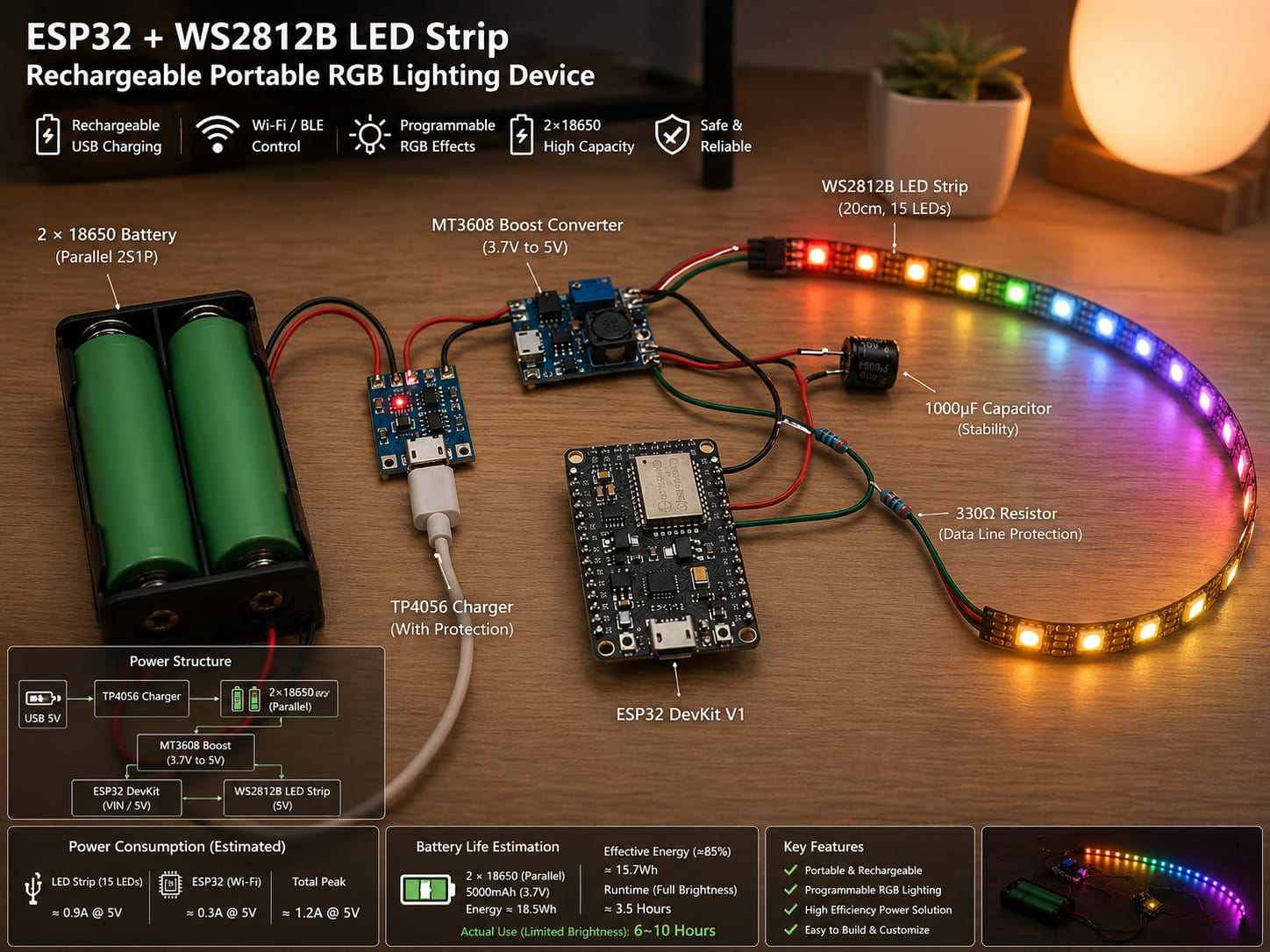
ESP32 + WS2812B LED Strip + 18650 Battery: Rechargeable RGB Lighting Device
A practical guide to building a rechargeable RGB lighting device using ESP32, WS2812B LED strip, and dual 18650 batteries. Covers hardware design, power calculation, and advanced lighting effects for real-world applications.
ESP32 + WS2812B LED Strip + 18650 Battery
A Rechargeable Portable RGB Lighting Device
This article presents a rechargeable portable RGB lighting device based on ESP32, using a WS2812B addressable LED strip and powered by two parallel 18650 lithium-ion cells.
The system supports USB charging, delivers stable 5V power for both logic and LEDs, and is suitable for ambient lighting, desktop light effects, interactive installations, or embedded product prototypes.
Project Goals and Key Features
Design Goals
- Portability: Fully rechargeable and wire-free.
- Precision Control: Individual RGB pixel control via MCU.
- Modularity: Simple circuit architecture for easy customization.
- Efficiency: Balanced brightness and long battery life.
Core Features
- ESP32 MCU: High-performance controller with Wi-Fi and BLE capabilities.
- WS2812B LEDs: Smart, single-wire programmable RGB pixels.
- Parallel 18650 Power: 2× cells for high capacity and current capability.
- Integrated Power Management: USB charging (TP4056) + 5V Boost (MT3608).
- Safety First: Software-based brightness limiting and hardware protection.
System Architecture Overview
Power Flow
USB 5V Input
      │
      ▼
TP4056 Li-ion Charger (with overcharge/discharge protection)
      │
      ▼
2 × 18650 Battery (Parallel, 3.0V – 4.2V)
      │
      ▼
MT3608 Boost Converter (Stepped up to 5V)
      │
      ├── ESP32 DevKit (VIN / 5V Pin)
      └── WS2812B LED Strip (5V VCC Pin)
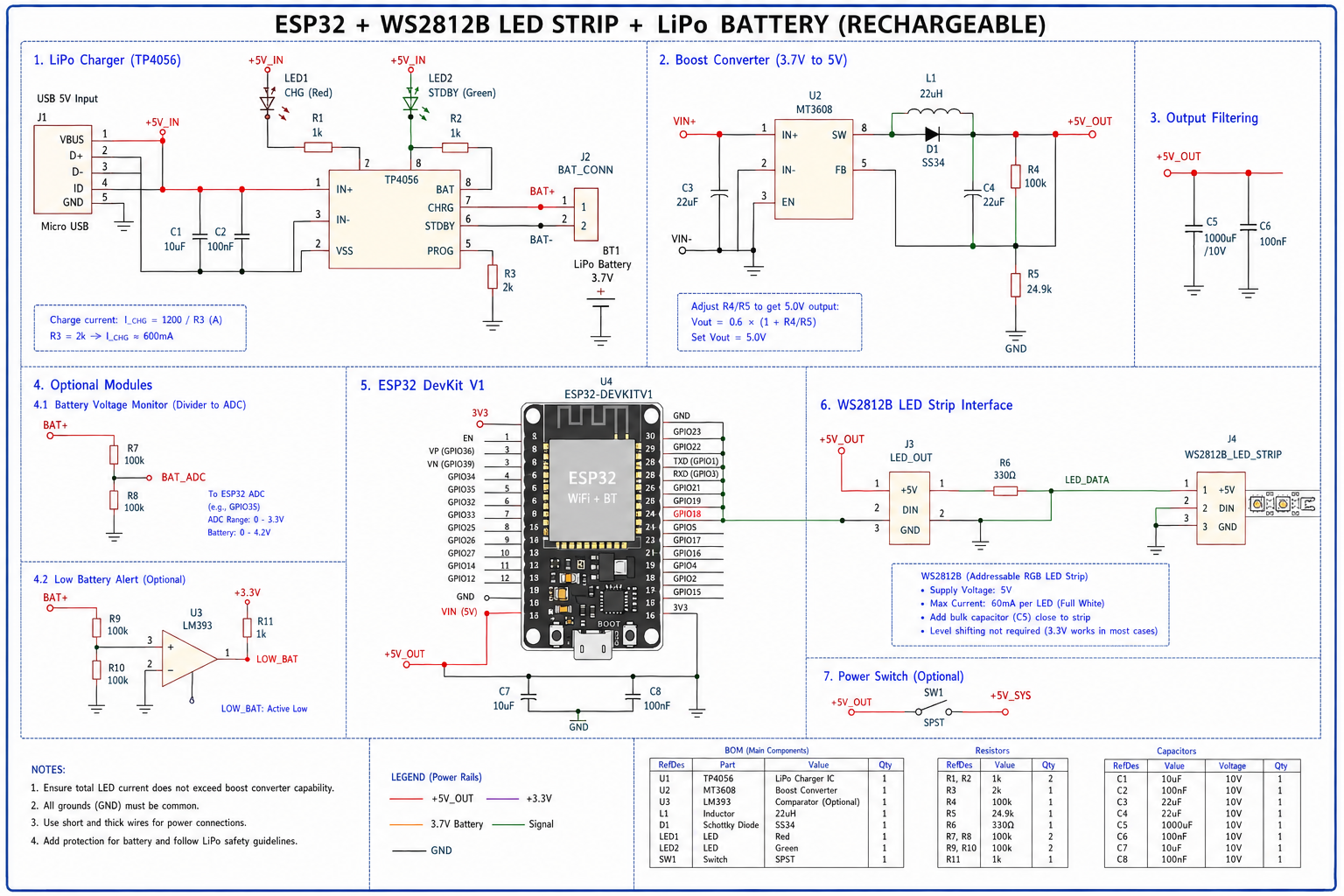
Bill of Materials (BOM)
1. Main Controller and LED Strip
| Item | Model | Specification |
|---|---|---|
| MCU | ESP32 DevKit V1 | Dual-core, 240 MHz, 3.3V GPIO |
| LED Strip | WS2812B | 5V, Individually addressable |
| LED Count | 12–15 LEDs | Approximately 20 cm strip |
2. Power and Management
| Item | Model | Description |
|---|---|---|
| Battery | 18650 Cells (x2) | Lithium-ion, connected in parallel |
| Charger | TP4056 Module | Micro-USB/Type-C with DW01 protection |
| Boost Converter | MT3608 | DC-DC Step-up, ≥2A output |
| Bulk Capacitor | 1000 µF / 10V | Electrolytic, for LED power stabilization |
3. Passive Components
| Item | Value | Purpose |
|---|---|---|
| Resistor | 330 Ω | Placed on LED data line to prevent signal spikes |
| Capacitors | 100 nF / 10 µF | Decoupling for ESP32 stability |
| Switch | SPST | Main physical power toggle (optional) |
Power Consumption and Battery Life
Consumption Calculations
- WS2812B LEDs: Single LED (Full White) ≈ 60 mA @ 5V.
- Total (15 LEDs): 15 × 60 mA = 900 mA (4.5 W).
- ESP32 MCU: * Idle: ~80–120 mA.
- Wi-Fi/BLE Active: 200–300 mA.
Peak System Current:
.
Runtime Estimation
- Total Capacity: 2500 mAh × 2 = 5000 mAh.
- Total Energy: .
- Efficiency Factor: Considering Boost Converter at ~85% efficiency.
- Usable Energy: .
- Max Runtime: .
- Mixed Use: With software brightness limiting (e.g., 30%), runtime extends to 6–10 hours.
Key Circuit Design Considerations
1. Parallel 18650 Cells
Connecting cells in parallel increases capacity and current overhead while reducing heat.
- ⚠️ Important: Ensure both cells are the same model, same voltage, and same health/age before connecting.
2. Signal Integrity and Stability
- 1000 µF Bulk Capacitor: Essential across the LED power rails to handle "inrush" current during color changes, preventing ESP32 brown-out resets.
- Logic Levels: While WS2812B expects 5V logic, most strips recognize the 3.3V signal from ESP32 GPIOs. For professional reliability, a 74AHCT125 level shifter is recommended.
ESP32 Arduino Control Code Example
Required Library: FastLED by Daniel Garcia.
#include <FastLED.h>

#define LED_PIN     18      // Data pin connected to ESP32
#define NUM_LEDS    15      // Number of LEDs in strip
#define BRIGHTNESS  80      // 0-255 scale (80 is approx 30% brightness)
#define LED_TYPE    WS2812B
#define COLOR_ORDER GRB

CRGB leds[NUM_LEDS];

void setup() {
  // Setup FastLED
  FastLED.addLeds<LED_TYPE, LED_PIN, COLOR_ORDER>(leds, NUM_LEDS);
  FastLED.setBrightness(BRIGHTNESS);
  FastLED.clear();
  FastLED.show();
}

void loop() {
  // Simple Breathing Blue Effect
  for (int b = 10; b < BRIGHTNESS; b++) {
    FastLED.setBrightness(b);
    fill_solid(leds, NUM_LEDS, CRGB::Blue);
    FastLED.show();
    delay(15);
  }

  for (int b = BRIGHTNESS; b > 10; b--) {
    FastLED.setBrightness(b);
    FastLED.show();
    delay(15);
  }
}
Advanced Application: Smart Ambient Light Bar
This prototype can be housed in a slim aluminum extrusion to create a professional-grade light bar.
Potential Enhancements:
- Connectivity: BLE connection to sync with PC system load or phone notifications.
- Interactivity: Capacitive touch sensors for mode switching.
- Automation: LDR (Light Dependent Resistor) for auto-brightness based on room lighting.
- Power Optimization: Utilize ESP32 Deep Sleep mode and battery monitoring via ADC to protect against cell depletion.
Conclusion
This ESP32-based architecture offers a robust foundation for portable lighting. By combining reliable power management (TP4056 + MT3608) with flexible software control, this design bridges the gap between a DIY hobbyist project and a viable commercial product prototype.
Share this article
Comments
0Please sign in to post a comment.
No comments yet.